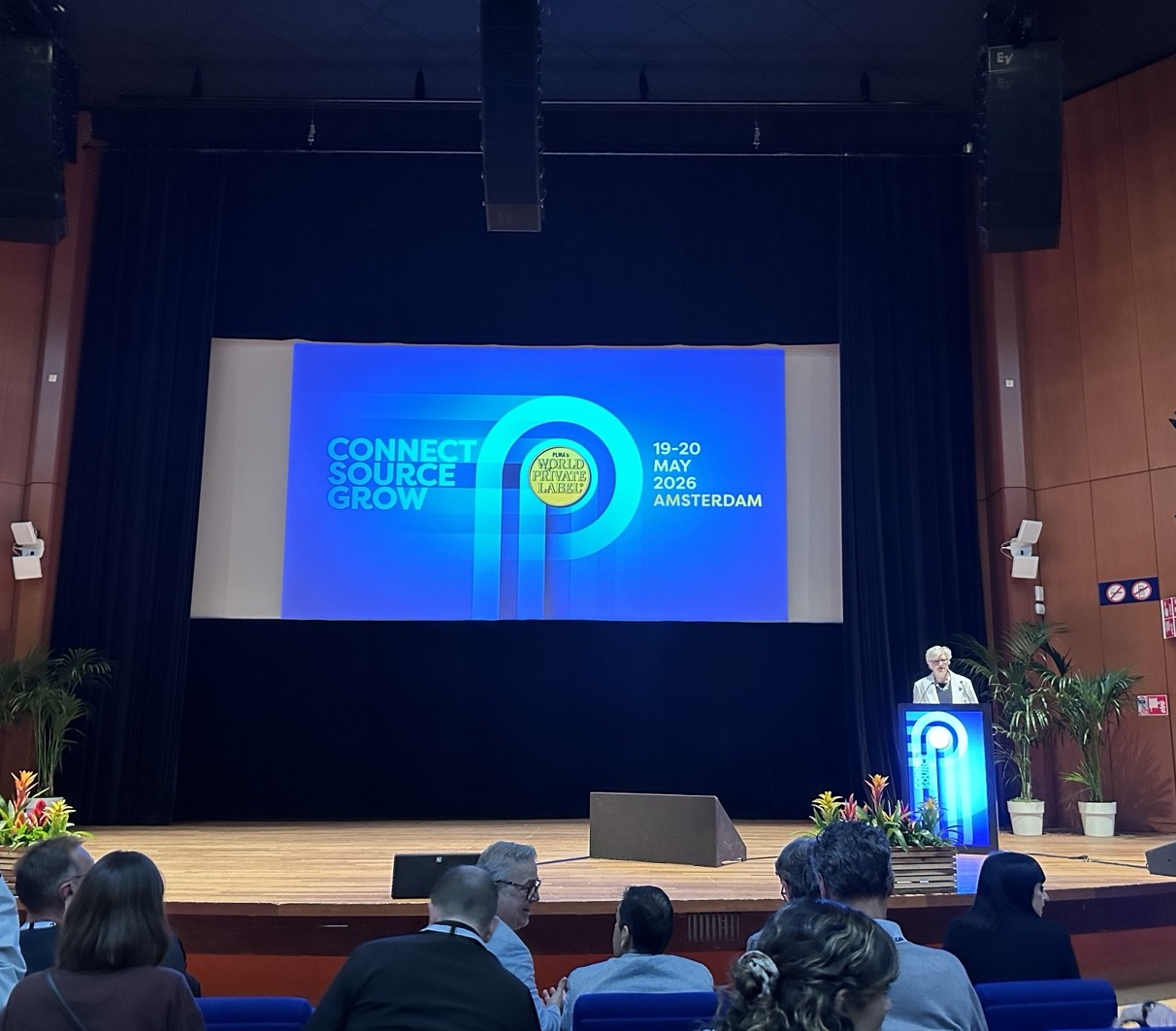
Before the exhibition halls of PLMA Amsterdam 2026 filled with buyers, producers and retail professionals from across Europe, the conference programme had already made one thing very clear: European grocery retail is entering a new phase.
Not necessarily a phase of rapid growth, but one of structural transformation.
This year’s presentations from McKinsey & Company, Eroski and trend analysts focused less on short-term optimism and more on adaptation. Across nearly every session, the same themes kept reappearing: margin pressure, slower growth, artificial intelligence, changing consumer behaviour and the growing strategic role of private label.
According to McKinsey’s “State of Grocery Retail Europe 2026” report presented during PLMA, grocery sales across Europe grew by 3.4% in 2025, but much of this growth was still driven by inflation rather than significant volume increases. Looking ahead, grocery volume growth in Europe is expected to remain almost flat through 2030. For retailers, this changes the game entirely. Expansion alone is no longer enough. Efficiency, differentiation and relevance are becoming the new priorities.
At the same time, private label continues strengthening its position across Europe. The report highlighted that private label now represents around 40% of grocery sales in Europe, while retailers increasingly use it not simply as a lower-cost alternative, but as a tool for innovation, customer loyalty and market differentiation.
This shift could also be clearly felt throughout PLMA itself. Private label is evolving far beyond traditional value positioning. Sustainability, premium concepts, convenience, functional food and visually distinctive products are becoming central parts of retailer strategies. In many categories, private label is now moving faster than traditional brands in responding to changing consumer expectations.
One of the strongest presentations came from Beatriz Santos of Eroski, who demonstrated how retailers are increasingly combining customer insight, data analytics and artificial intelligence to shape category decisions and private label development. What stood out was not only the scale of technology being used, but the mindset behind it. Retailers are moving away from simply offering “more products” and focusing instead on offering more relevant products.
Another important shift discussed throughout the conference was convenience. Consumers continue looking for faster, easier and more flexible meal solutions, while younger generations increasingly prioritise ready-to-eat and ready-to-heat products over traditional cooking habits. According to McKinsey’s findings, convenience and foodservice categories are now growing faster than traditional grocery retail across Europe.
This creates particularly interesting opportunities for Baltic producers. Companies from Lithuania, Latvia and Estonia showcased strong capabilities in categories that directly align with these wider European trends - functional snacks, frozen products, plant-based innovation, ready meals, premium ingredients and health-oriented concepts.
Artificial intelligence was another dominant topic across the seminars. AI and automation have now become the second-highest priority for grocery CEOs in Europe, immediately after cost and margin pressure. Yet many speakers acknowledged that the industry is still at an early stage of understanding how AI will truly reshape retail operations. The discussion is no longer about experimentation alone, but about how AI may influence pricing, forecasting, category management, customer targeting and even supplier relationships in the years ahead.
Perhaps the most interesting takeaway from PLMA Amsterdam 2026 was that grocery retail is becoming less predictable, but also more dynamic. Consumer loyalty is fragmenting, online and offline behaviours are diverging, and retailers are searching for new ways to remain relevant in increasingly competitive markets.
For Baltic producers looking towards Benelux and wider European expansion, this environment creates both pressure and opportunity. Buyers are becoming more selective, but they are also increasingly open to flexible, innovative and specialised suppliers able to respond quickly to market shifts.
PLMA Amsterdam 2026 showed that the future of grocery retail in Europe will likely belong not to the biggest players alone, but to the businesses capable of adapting fastest to changing consumer expectations, technological transformation and new forms of collaboration.

